Some days the problem we solve is technical. Today it was financial — and the client didn’t even know money was leaking.
The silent margin killer in every large online store
If you run an online store with hundreds or thousands of products from multiple suppliers, you know this moment: a supplier emails a new pricelist. Their costs went up. Some products by 5%, some by 15%, a few are discontinued.
What happens next in most businesses? The email gets forwarded. Someone is going to “get to it.” It sits in a folder. Three weeks later you’re still selling Product X at last quarter’s cost price — except now your landed cost is 12% higher and your margin on every sale of that product has evaporated. You won’t find out until you do a quarterly review, if you do one at all.
Multiply that across six suppliers, 3,000 products, and price changes every few months. It’s not a process problem. It’s a structural one — the way most online stores are set up, keeping prices current is a full-time job that nobody has time to do properly.
What we built — and why it took 30 seconds to prove it works
We connected the supplier pricelist directly to the live store. Not through a manual import. Not through a spreadsheet someone has to maintain. Through an intelligent system that reads the supplier’s document, finds every matching product in the store, shows exactly what will change, and — once confirmed — updates every price automatically.
Here’s what that looks like in practice. We dropped a supplier’s April pricelist into our system — 16 sheets covering multiple brands, hundreds of products. We asked it to check whether a specific product group had been given the right cost price. Within 30 seconds it had read every product code, matched them against the live store, and reported back: products exist, prices are showing, but there is no supplier cost recorded behind any of them. Meaning the store has been selling those products with no way to know if the margin was correct.
That gap — products with visible prices but no verified cost behind them — is exactly the kind of thing that costs a business real money quietly, over time, without triggering any alarm.
The aha moment for any store owner
The system works in three ways depending on what you need:
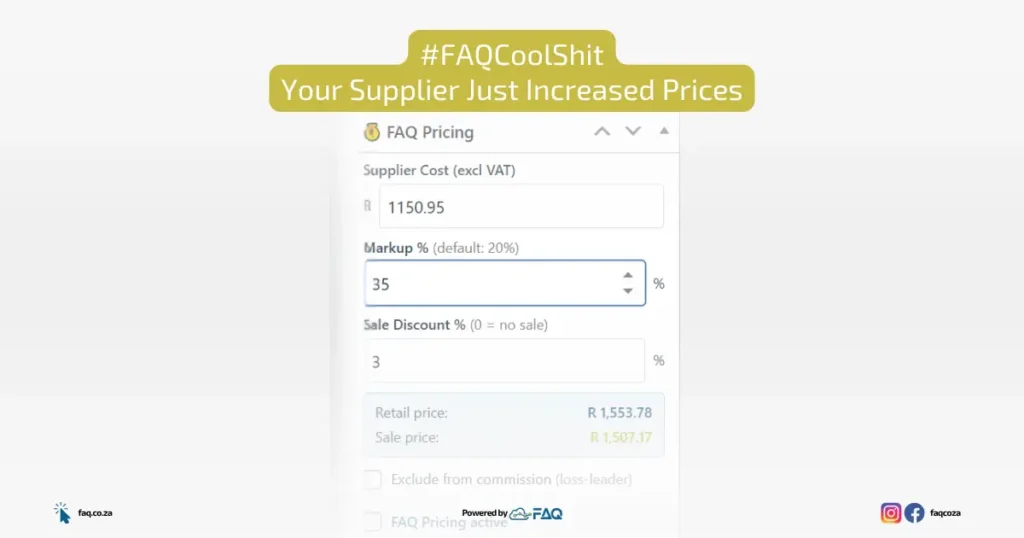
For a single product — open it, update the supplier cost, the retail price recalculates instantly. Done in seconds.
For a batch update — export your full catalogue to Excel, update the cost column for the products that changed, reimport. Every retail price recalculates automatically on the way back in. No manual price editing. No formula errors. No missed products.
For a supplier pricelist — drop the file into our system. It reads the document, matches product codes against your store, shows you a clear picture of what changed and by how much before touching anything. You confirm, it updates. Products in the pricelist that aren’t in your store yet go into a separate review list for you to decide whether to add them. Nothing happens automatically without your sign-off.
In all three cases, the retail price is always calculated from a verified cost plus your agreed markup. Not guessed. Not manually typed. Calculated — and recalculated every time the cost changes.
What this means for your business
If a supplier increases their costs by 10% and your team doesn’t update the store for three weeks, you’ve absorbed that cost on every sale during that window. On a busy product that might be 50 orders. On a high-value product, that’s a number worth knowing.
The stores we manage don’t have that problem anymore. Supplier sends a pricelist — the system processes it, we review the changes, prices update. The margin you agreed on is the margin you get.
FAQ is Your Partner in Online Sales. We manage WooCommerce stores for product businesses — including everything that keeps your pricing, margins, and supplier relationships running cleanly in the background. If price management is eating your team’s time or quietly eating your margin, let’s talk.
#FAQCoolShit #WooCommerce #SupplierManagement #Ecommerce